How New Do Cars Need To Be?

By Sam Abuelsamid, VP of Market Research
Last week at an Automotive Press Association event in Detroit, former Bank of America automotive analyst John Murphy presented the first edition of his Murphy Automotive Product Pipeline. Murphy recently went out on his own, and the pipeline report is a reconstituted version of the Car Wars report he's been preparing for nearly 30 years. In it, he makes some predictions on where the U.S. automotive industry is headed over the next five years, and I have some thoughts on a couple of key areas.
One element of Murphy’s reports that's remained constant over the years is a look at the age of vehicles currently on sale and when redesigns are due. The average age of a manufacturer's fleet has long been an indicator of brand health: automakers that let vehicles sit too long without a major redesign risk missing out on growth and profits.

Between 2000 and 2020, the average age of a vehicle since its last redesign mostly hovered between two and three years, with most vehicles on a four-to-five-year product cycle. So if you bought a new vehicle and kept it for four to six years, which is pretty common, the next time you walked into a dealer to buy a replacement, it likely looked quite different and new. But if you walked into a showroom after five years and the vehicles looked exactly like the one you were about to trade in, you might wonder why you’re bothering, especially if that same-looking vehicle now costs 20 to 30% more. In that case, you might be inclined to look elsewhere, or just decide to keep what you have rather than take on a higher car payment.
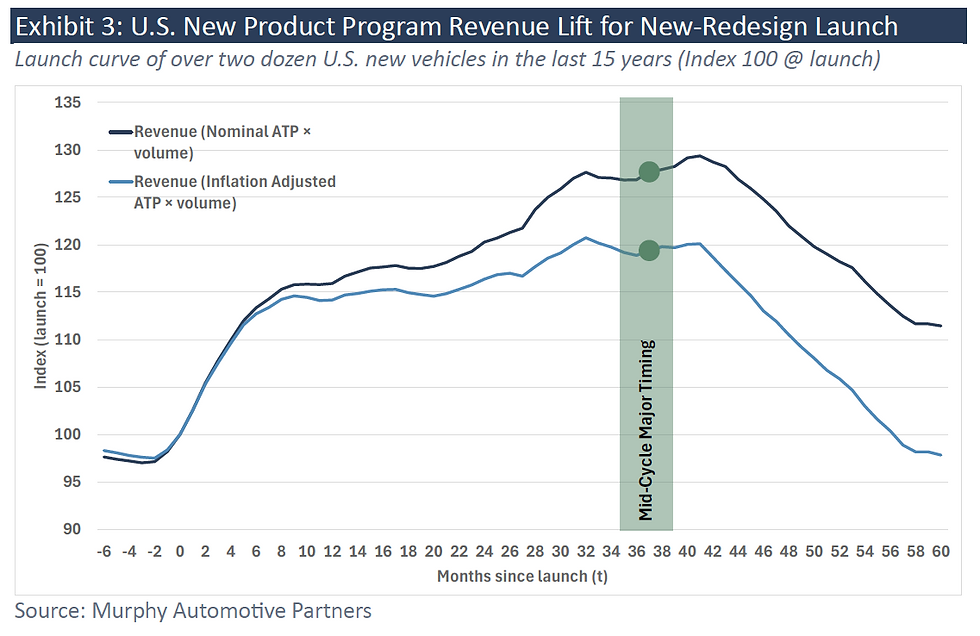
Then there’s the economics of the business, for both manufacturers and dealers. When a new product launches, revenue (average transaction price x sales volume) climbs quickly from zero during the initial ramp-up, then plateaus for a few years. According to Murphy’s data on over two dozen vehicles over the past 15 years, that plateau begins about 6 to 8 months after launch, gradually rising to a peak around 30 months, and a mid-cycle refresh keeps it near that peak for another year or so. Beyond the 40-month mark, demand starts to taper off as customers look for something fresh, and manufacturers and dealers have to lean harder on financial incentives, which eat into revenue. By the five-year mark, revenue is starting to go negative.

Keeping most products less than five to six years old maximizes revenue and profit. Refreshing more frequently, which is becoming the norm, costs a lot of money and skips over the most profitable stretch of that revenue curve. That's become standard practice in China, where most manufacturers are turning over product generations on a two-to-three-year cycle, and losing money in the process.

There are, of course, exceptions. The Dodge Durango is now 15 years past its last full redesign and doesn’t look notably different from a 2011 model. Yet 2025 was the nameplate's best sales year on record, with over 81,000 units sold in the U.S. But that’s an anomaly.
Do Customers Actually Want so Much Fresh Product?
What Murphy says is certainly true looking backward. But the market is evolving. Today, the largest segment of the new-vehicle market by a wide margin is the compact-to-midsize crossover. Let’s be honest: these vehicles mostly look very similar. If you line them up in profile, there isn't much differentiation, especially once you factor in that the vast majority are sold in some shade of monochrome: grey, silver, black, or white.
Those of us following the industry pay close attention to design details, but most consumers don’t. A new family recently moved into our neighborhood with two current-generation Honda CR-Vs, one in grey and the other in dark blue that looks more like grey. Walking my dog, I saw a third vehicle in the driveway and thought they had yet another CR-V. It wasn’t until I got closer that I realized it was a Kia Sportage. Same size, general shape, and nearly the same color.
What an increasing number of people actually seem interested in is getting over-the-air (OTA) software updates that improve their user experience, rather than some slightly different sheetmetal. They want a better in-vehicle experience, occasional new features, new apps to stream their media, and better navigation. A full vehicle redesign can cost $1 to 2 billion, while an OTA update can be deployed at a fraction of the cost.
Murphy projects that by 2028, the average age of cars for sale in the U.S. will be nearly five years old, meaning many will be nearly 10 years old or more. Tesla only occasionally does minor visual refreshes of its models, and while its sales are down, that’s more likely due to other factors, like the loss of EV tax breaks and growing public disdain for Elon Musk. Tesla owners still love it when they get a fresh software update every few weeks.
Vehicle age is likely to become a less compelling factor for consumers as more vehicles migrate to a software-defined architecture in the years ahead. What automakers really need to focus on is making sure their software works reliably from day one, then keeping that experience fresh for as long as customers own the vehicle. That's how they’ll earn recurring revenue from connectivity services.


Comments